

Must-Have Diagnostic Tools for Vehicle Maintenance

Today’s theme: Must-Have Diagnostic Tools for Vehicle Maintenance. Meet the gear that turns guesswork into confident fixes, saves weekends, and keeps your car purring. Dive in, share your go‑to tools, and subscribe for hands-on tips, checklists, and real-world diagnostic stories.

OBD-II Scanners: Your First Line of Insight

Choosing the Right Scanner

Decide between a basic code reader and a pro-grade, bi-directional scan tool that supports enhanced manufacturer PIDs, module access, service resets, and updates. Check protocol coverage, update cadence, and community support before trusting it with your driveway diagnostics.

Reading Live Data Like a Pro

Track short- and long-term fuel trims, oxygen sensor switching, MAF or MAP behavior, coolant temperature, and misfire counters. Correlate data under specific loads and temperatures, and snapshot anomalies. Share your favorite PID combinations in the comments to help fellow readers learn faster.

A Quick Story from the Road

On a highway limp-mode scare, a compact scanner revealed P0101 with strange fuel trims. Freeze-frame showed 65 mph at light throttle. That pointed to an intake leak, not a failing MAF. A five‑minute smoke test solved weeks of worry—lesson learned.

Digital Multimeters: Electrical Truth Serum

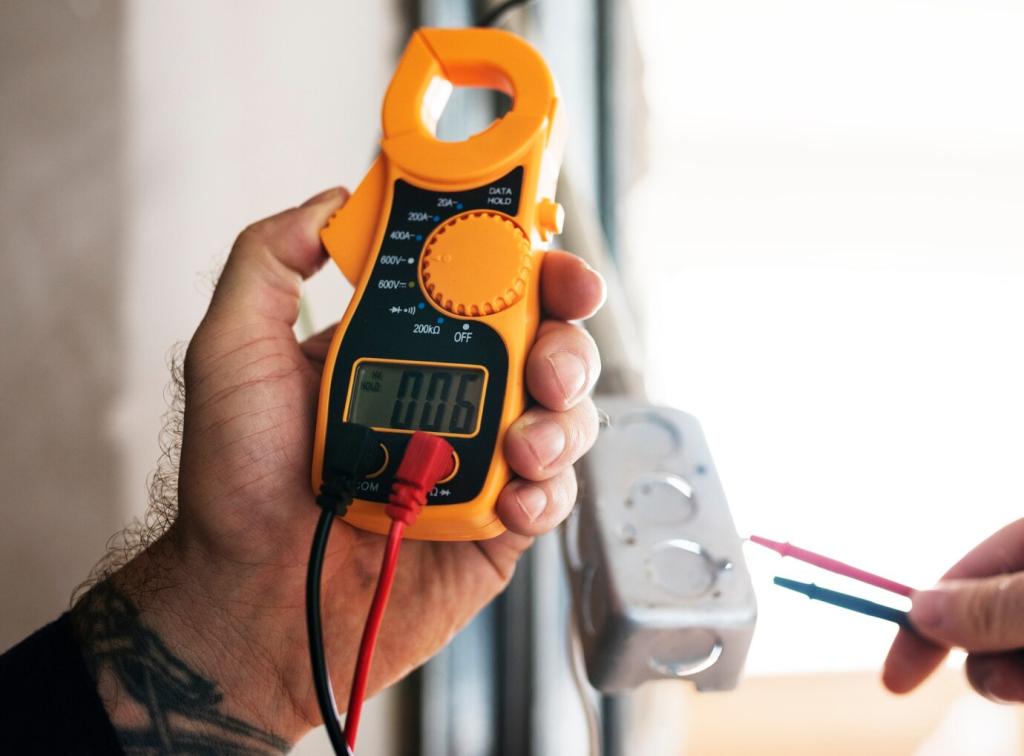
Prioritize DC voltage, continuity, resistance, diode test, min/max capture, and duty cycle. Use quality leads, back-probe gently, and log readings against conditions. Autoranging is convenient, but manual range control often speeds diagnosis and avoids misreading rapidly changing signals.

Battery and Charging System Testers: Starting Strong

Cold Starts and Cranking Amps

Look beyond voltage and measure CCA performance. During crank, voltage should typically stay above 9.6 volts at moderate temperatures. Remove surface charge before testing, and compare readings to battery labels. A borderline battery often masquerades as random sensor glitches and hard shifts.

Alternator Health at a Glance

Charging voltage usually lives around 13.8 to 14.6 volts, adjusted by temperature and load. Check ripple with an AC setting or scope, and inspect belt tension and pulley condition. Voltage-drop testing on the B+ cable reveals hidden resistance that starves modules and lights.

Real-World Save

One winter morning, a rideshare driver feared a dying starter. A conductance test flagged a sulfated battery with weak reserve capacity. After replacement, cold cranks improved, idle stabilized, and radio glitches vanished. Share your battery horror stories—and what finally fixed them.

Pressure, Vacuum, and Compression: Gauges That Tell Secrets

Compression tests capture peak pressure; leak-down tests quantify where air escapes. Listening at intake, exhaust, or oil fill locates valves, rings, or head gaskets. Record cylinder-by-cylinder results, warm engine conditions, and throttle position to build a reliable baseline for future checks.

Pressure, Vacuum, and Compression: Gauges That Tell Secrets

A proper fuel pressure gauge confirms delivery and regulator behavior. Slow bleed-down suggests leaky injectors; erratic readings can indict pumps or filters. Know your platform’s spec—return, returnless, or direct injection—and follow pressure-release precautions to keep fingers, hoses, and paint safe.


Thermal and Visual Diagnostics: See the Invisible

Use an IR gun to verify thermostat operation, spot dragging brakes, and compare catalytic converter inlet and outlet temperatures. Thermal patterns highlight partially clogged radiators and misfiring cylinders. Share a snapshot of your most surprising heat discovery and what it ultimately uncovered.

Thermal and Visual Diagnostics: See the Invisible

A compact borescope slips into spark plug holes or intake tracts, revealing cylinder walls, valve deposits, and turbo blades. Seeing carbon, scoring, or coolant trails accelerates decisions. Fewer guesses, fewer gaskets, and more certainty—post your favorite borescope tip for clearer images.
Electronic testers estimate brake fluid water content and boiling point. Elevated moisture invites corrosion and fade under hard stops. Test annually, especially in humid regions, and note color alone is unreliable. What percentage made you finally flush yours? Tell us in the comments.
A scanner graphing wheel speed sensors exposes dropouts from damaged tone rings, debris, or frayed wiring. Compare signals left to right under the same speed. If you own a scope, capture waveform amplitude and symmetry to confirm clean, consistent sensor operation over bumps.
Use a dial indicator on the rotor to quantify runout, and a micrometer for thickness variation. Clean hub faces thoroughly and torque lugs in sequence. Accurate readings guide machining or replacement choices and prevent the dreaded comeback for persistent pedal pulsation.
Onryapidekorasyon
Privacy Overview

This website uses cookies so that we can provide you with the best user experience possible. Cookie information is stored in your browser and performs functions such as recognising you when you return to our website and helping our team to understand which sections of the website you find most interesting and useful.